
Case Study Scaling Diagnostic Services Through Thoughtful Geographical Expansion
By Dr. Arpan Gandhi
drarpangandhi.org and arpangandhi@gmail.com
In 2010, I was involved in setting up diagnostic laboratory services in a part of India where the terrain was challenging and access—to kits, logistics, and trained manpower—was even more difficult. The immediate need there was not scale in numbers, but impact on patient care. Being unfamiliar with the region, I worked closely with local clinicians to understand their realities and designed focused test panels relevant to their practice. Within two years, volumes grew steadily—but more importantly, clinical decision-making and patient outcomes improved significantly.
That experience stayed with me, because it reshaped how I think about geographical expansion.
Context
Geographical expansion is often viewed as a natural next step for diagnostic laboratories. New locations promise visibility, market presence, and growth in volumes. In one engagement, I worked with a diagnostic setup that was keen to expand beyond its existing footprint.
The intent was clear: increase reach, grow numbers, and establish a wider network. However, beneath the ambition lay uncertainty. Demand projections were based on assumptions rather than data. Manpower planning felt optimistic. Systems that worked well at one location had not yet been tested at scale.
From experience, I have learned that expansion pressure often precedes clarity.
My Initial Concerns
When laboratories talk about expansion, the discussion usually starts with locations and equipment. I tend to start elsewhere.
My initial questions were simple but uncomfortable:
- Is there a real clinical demand, or only a perceived market opportunity?
- Will volumes ramp up gradually, or are we expecting immediate scale?
- Can existing systems absorb growth, or will people absorb the pressure instead?
These questions matter because premature expansion rarely fails loudly. It fails quietly—through staff fatigue, underutilised resources, and erosion of quality.
Why Numbers Alone Are Misleading
One of the most common mistakes I have seen is committing to manpower and infrastructure based on projected numbers rather than lived workflows.
On spreadsheets, volumes scale smoothly. On the ground, they do not.
Early phases of expansion are often uneven. Some days feel underwhelming. Others feel stretched. This unpredictability creates anxiety among teams, particularly when new hires feel unsure about their role, relevance, or sustainability.
In my experience, people experience scale emotionally long before organisations experience it financially.
Reframing Expansion as a Systems Problem
Rather than treating expansion as a real estate or logistics exercise, I reframed it as a systems challenge.
The key question was not how fast we could expand, but how predictably we could do so.
This meant shifting focus from aggressive targets to controlled phases. Growth had to feel stable to the people delivering it, not just attractive to those planning it.
My Approach
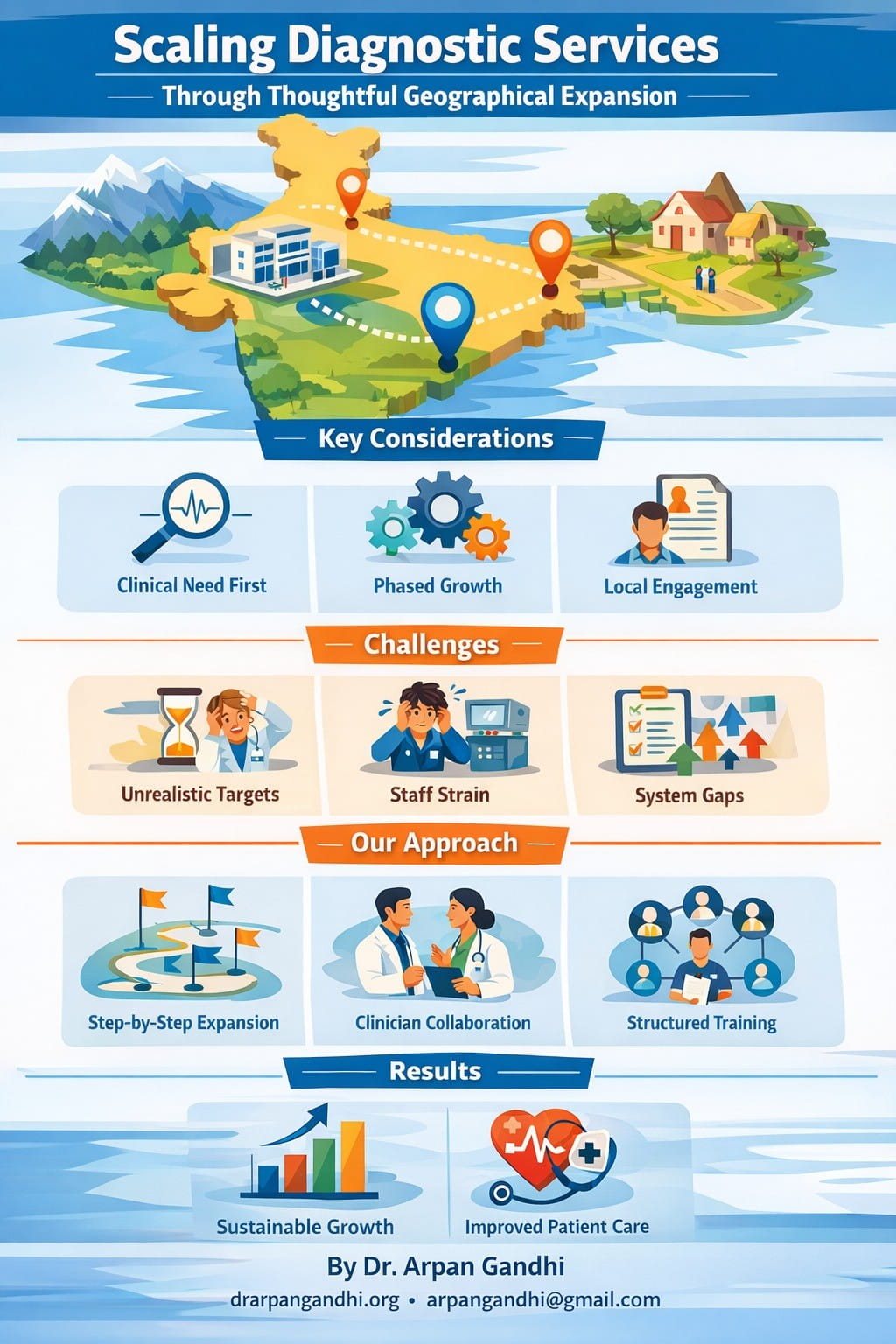
I approached this engagement with a few core principles:
- Phased expansion is safer than rapid replication
- Manpower should follow thresholds, not hope
- Clinical engagement must precede menu expansion
Instead of launching multiple sites simultaneously, expansion was planned in stages. Each phase had clearly defined success markers before moving to the next.
Manpower decisions were tied to volume thresholds rather than projections. This reduced anxiety and avoided prolonged periods of underutilisation.
Engaging Clinicians Early
One of the most important aspects of expansion is clinical adoption. Tests and services do not scale simply because they are available.
I encouraged early engagement with clinicians to understand how new services would fit into existing workflows. This helped align expectations and avoided launching services that looked promising but lacked real-world relevance.
In my experience, expansion that ignores clinical thinking creates availability without utilisation.
Systems Before Scale
Before adding new locations, we examined whether existing systems could absorb complexity. This included:
- Reporting workflows
- Escalation pathways
- Training frameworks
- Quality monitoring mechanisms
Where gaps existed, they were addressed first. Expansion without systems simply transfers instability to a larger geography.
What Changed Over Time
As expansion progressed in a phased and deliberate manner, several outcomes became visible.
Volumes grew steadily rather than dramatically. Teams felt less pressure to “justify” their existence. New hires integrated more smoothly. Quality indicators remained stable rather than fluctuating with growth.
Importantly, leadership retained visibility into ground realities. Decisions were adjusted based on feedback rather than assumption.
Impact on People and Performance
One of the most reassuring outcomes was the effect on people. Expansion did not feel chaotic. Staff felt prepared rather than rushed. Supervisors remained confident rather than defensive.
Growth became something the organisation absorbed collectively rather than something individuals had to carry personally.
Key Learning
This engagement reinforced a lesson I now apply consistently:
Geographical expansion succeeds when systems scale before numbers do.
Growth that feels predictable to people becomes sustainable for the organisation.
Reflection
Expansion is not just about reach. It is about responsibility.
In diagnostic laboratories, scaling services without scaling systems risks quality, morale, and trust. When expansion is thoughtful, phased, and clinically aligned, it strengthens institutions rather than stretching them.
Why This Matters
This approach helps laboratories to:
- Expand without destabilising teams
- Align manpower with real demand
- Maintain quality during growth
- Build clinician confidence in new services
In my experience, sustainable growth is always quieter than aggressive expansion—but far more durable.