June 25, 2026
Why Most Diagnostic Startups Fail: Lessons for Founders and Investors
The diagnostics sector has never been more exciting. Advances in genomics, artificial intelligence, precision medicine, digital pathology, and healthcare technology are creating unprecedented opportunities for innovation. Every year, new diagnostic ventures enter the market with ambitious visions and promising technologies. Yet despite the potential, many diagnostic startups struggle to achieve sustainable success.
Throughout my professional journey, I have observed that failure occurs not because of a lack of innovation — more often, it results from an imbalance between technology, execution, quality, and business fundamentals.
One of the most common mistakes startups make is focusing excessively on technology while underestimating operational complexity. Developing a novel test, platform, or technology is only the beginning. Organizations must also establish quality systems, build operational workflows, ensure regulatory compliance, manage customer relationships, train teams, and deliver consistent performance at scale.
Another challenge is the assumption that clinical adoption will occur automatically. Healthcare professionals are appropriately cautious when evaluating new technologies. Clinical validation, evidence generation, trust, and real-world utility are often more important than technical sophistication alone. Startups that fail to understand this reality frequently struggle to gain meaningful market traction.
.png)
Leadership also plays a decisive role. Diagnostic ventures require leaders who can balance innovation with execution, ambition with discipline, and growth with sustainability. The most successful founders are not only visionaries — they are builders who understand how to create organizations capable of delivering consistent value over time.
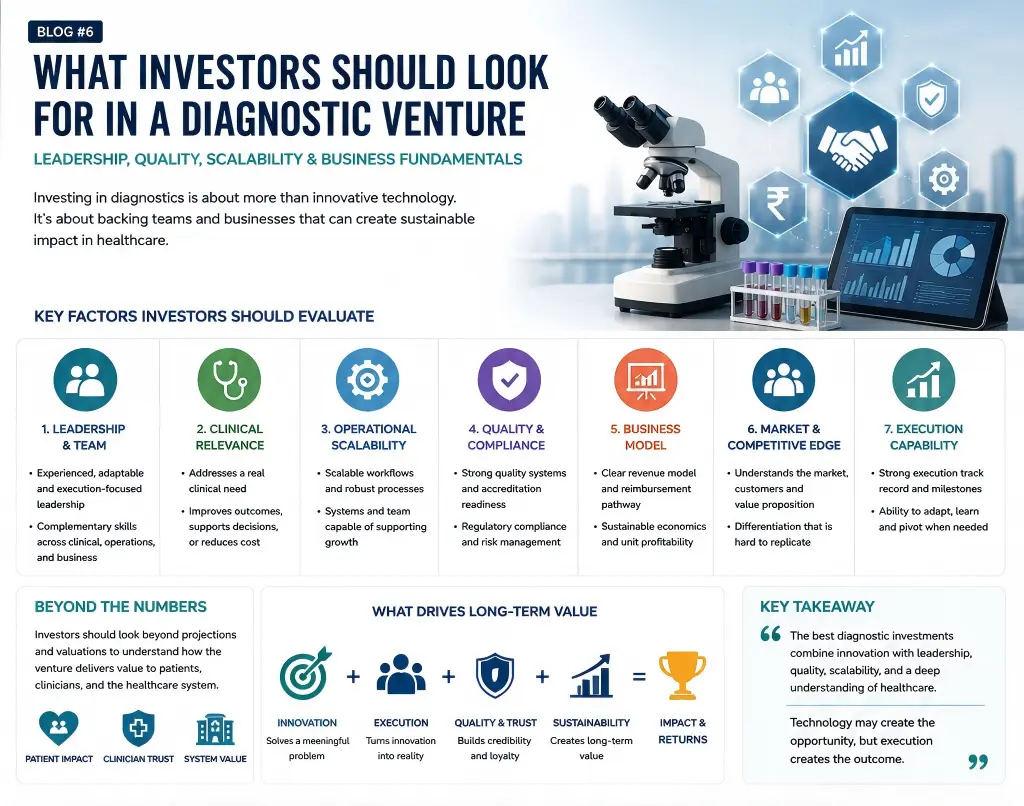
Funding is important, but capital alone does not guarantee success. Investors increasingly recognize that sustainable healthcare ventures require strong leadership teams, operational maturity, quality-focused cultures, and realistic growth strategies. Organizations that combine these elements often outperform competitors with greater resources but weaker execution.
The emergence of genomics, artificial intelligence, and precision medicine will undoubtedly create new opportunities for healthcare innovation. However, the fundamental principles of success remain unchanged. Healthcare organizations must earn trust, demonstrate reliability, deliver quality, and solve meaningful clinical problems.
In my experience, the most successful diagnostic ventures do not win because they possess the most advanced technology. They succeed because they integrate innovation with quality, leadership, governance, operational excellence, and patient-centered thinking.
For founders, the lesson is clear: build an organization, not just a product.
For investors, the message is equally important: evaluate execution capability as carefully as technological innovation.
In healthcare, sustainable success is rarely driven by technology alone. It is built through leadership, trust, quality, and disciplined execution.