July 23, 2026
Pre-analytical Errors: The Most Preventable Cause of Laboratory Mistakes
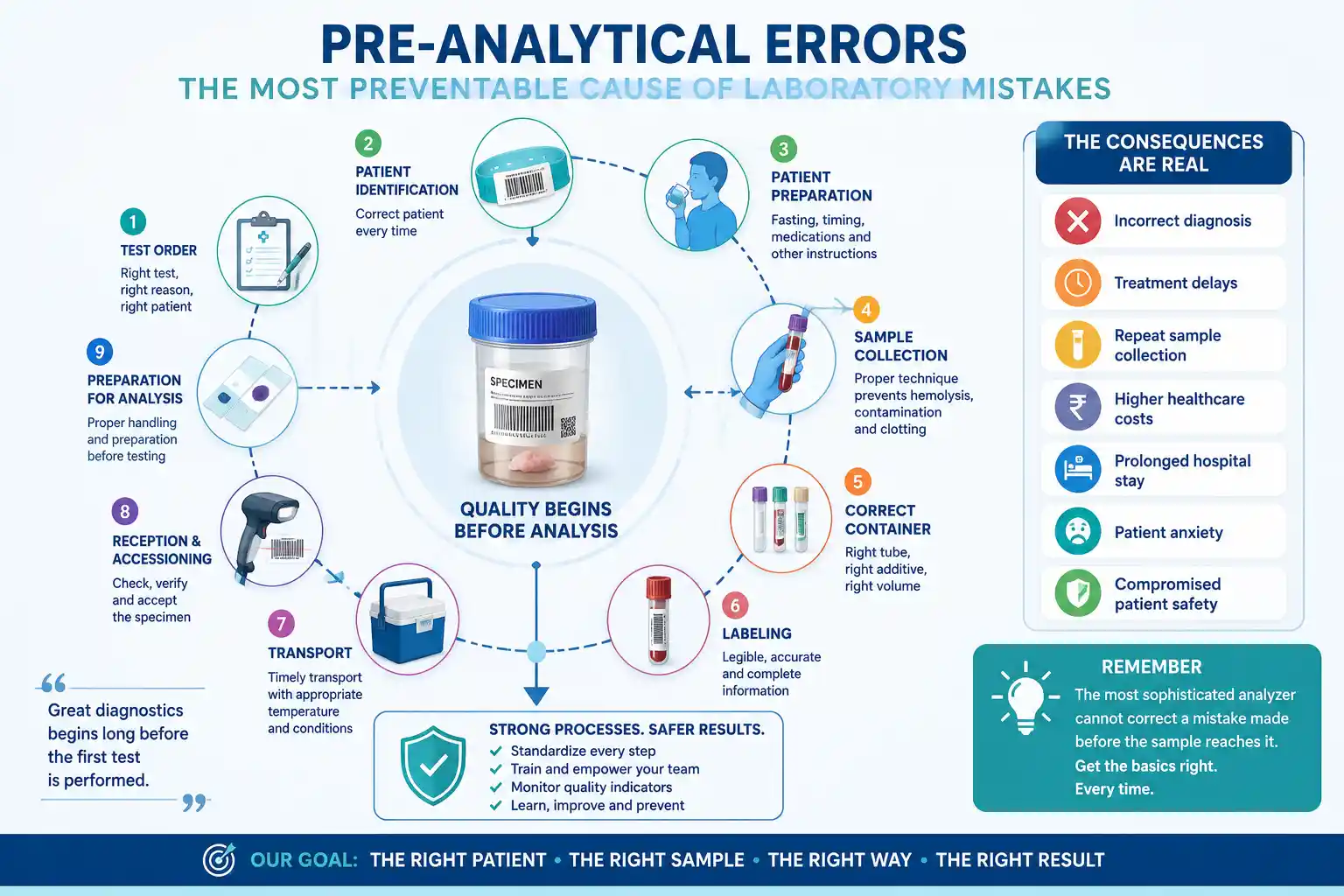
Before I began working in laboratory medicine, I believed that the most critical part of diagnostics happened inside the laboratory — under the microscope, on sophisticated analysers, or through advanced molecular testing. Nearly three decades later, I have come to appreciate a different reality: the quality of every laboratory result is determined long before a specimen reaches the analytical bench. Across healthcare systems worldwide, studies consistently show that nearly 60–70% of laboratory errors occur during the pre-analytical phase, making it the single largest and most preventable source of diagnostic error.
The pre-analytical phase begins the moment a clinician orders a test. It includes patient identification, patient preparation, specimen collection, selection of the correct container, labelling, transportation, storage, accessioning, and preparation for analysis. Every one of these seemingly routine steps influences the final laboratory report. A state-of-the-art analyser cannot compensate for a mislabelled blood sample, a poorly fixed biopsy, a haemolysed specimen, or an improperly transported culture. As laboratory technology continues to evolve with automation, digital pathology, and artificial intelligence, it is easy to overlook the fundamentals — yet the truth remains unchanged.
During audits and quality improvement initiatives over the years, I have found that the same preventable mistakes recur irrespective of whether the laboratory serves a small clinic or a large tertiary care hospital. Incorrect patient identification remains one of the most serious errors — even a perfectly performed test becomes clinically useless if it belongs to the wrong patient. Equally common are inadequate patient preparation, inappropriate timing of assays, poor venepuncture technique causing haemolysis or clotting, and selection of the wrong collection tube — all of which may significantly alter or invalidate laboratory values.
In histopathology, delayed fixation or inadequate formalin volume can produce autolysis, distorted tissue morphology, failed immunohistochemistry, and compromised molecular testing — changes that no pathologist can reverse later. Transportation delays, temperature fluctuations, improper storage, and incomplete documentation further increase the risk of inaccurate or delayed diagnoses. The consequences extend well beyond the laboratory: repeat sample collection, delayed surgery, unnecessary investigations, prolonged hospital stays, increased healthcare costs, avoidable patient anxiety, and, most importantly, compromised patient safety.
The encouraging aspect of pre-analytical errors is that, unlike many analytical challenges, they are largely preventable through strong leadership, standardised processes, continuous education, and a culture of quality. Standard operating procedures, competency-based staff training, clinician awareness programmes, barcode-based patient identification, clearly defined specimen rejection policies, regular monitoring of quality indicators, root cause analysis of incidents, and encouragement of near-miss reporting all contribute to safer laboratory practice. The best laboratories are not those that simply detect mistakes — they are those that design systems in which mistakes become increasingly difficult to make.
Throughout my career, I have become convinced that laboratory excellence is shaped less by the sophistication of equipment and more by the commitment of people who understand that every step matters. As laboratory medicine continues to embrace digital pathology, molecular diagnostics, and artificial intelligence, we must remember that these remarkable innovations can only perform as well as the specimens they receive. Great laboratories are built on reliable processes, disciplined teamwork, and continuous improvement — because in the end, the most advanced diagnostic technology in the world cannot rescue a specimen whose quality was compromised before it ever reached the bench.