
Case Study Correcting Pre-Analytical Vulnerabilities in Diagnostic Workflows
By Dr. Arpan Gandhi
drarpangandhi.org and arpangandhi@gmail.com
Where the Problem First Became Visible
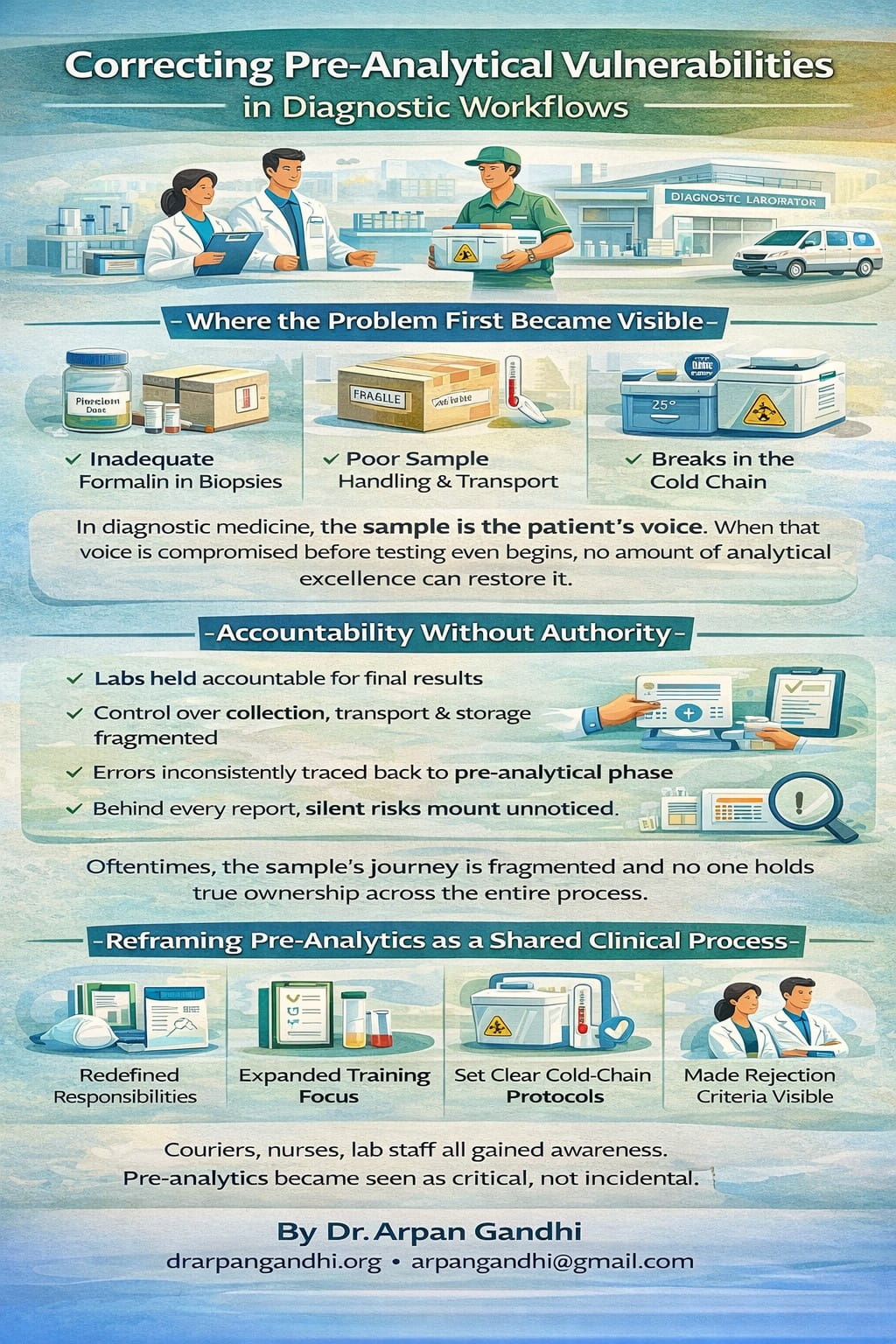
Over the years, I began noticing patterns that were deeply unsettling, not because they were rare, but because they were becoming routine. Biopsies would arrive with inadequate formalin, sometimes barely covering the tissue. Courier service providers handled clinical samples no differently from routine parcels—left in the sun, stacked without care, delayed without communication. Cold chains were broken, often unknowingly, and by the time the sample reached the laboratory, the damage had already been done.
What followed was almost predictable. Reports would be questioned. Clinicians would ask why findings did not match the clinical picture. Occasionally, the blame would quietly shift toward the laboratory. Each time this happened, it forced me to pause. At which point did things go wrong? And more importantly, who truly owned that failure?
What troubled me was not a single error, but the fragmentation of responsibility. Each handover diluted ownership. Everyone did their part, yet no one owned the whole. In diagnostic medicine, the sample is the patient’s voice. When that voice is compromised before testing even begins, no amount of analytical excellence can fully restore it. Over time, this realization reshaped how I viewed pre-analytics—not as a technical step, but as a clinical responsibility.
Accountability Without Authority
What made the problem particularly complex was the imbalance between accountability and control. Laboratories are ultimately held responsible for reports, yet the most vulnerable steps—collection, labeling, transport, and storage—often lie outside direct laboratory authority.
In hospital settings, samples are collected by nursing teams working under immense pressure. In outreach models, samples pass through multiple third-party hands before reaching the lab. Each interface introduces variability, yet governance remains fragmented. When errors surface, discussions usually begin at the reporting stage rather than tracing the journey of the sample.
Over time, I realized that this mismatch creates silent risk. Laboratories are expected to defend results without having influenced the conditions under which samples were obtained. This dynamic discourages early reporting of issues and normalizes compromise. In my experience, unless this imbalance is acknowledged openly, pre-analytical failures persist quietly while analytical excellence is unfairly scrutinized.
Reframing Pre-Analytics as a Shared Clinical Process
Addressing pre-analytical vulnerabilities required a fundamental shift in thinking. Instead of treating pre-analytics as a peripheral or logistical problem, I began to approach it as a shared clinical process that required the same seriousness as interpretation and reporting.
The first step was clarity. We worked on redefining responsibilities at every interface—who collects, who checks, who transports, and who escalates concerns when something is not right. Training was redesigned to move beyond technical instruction toward explaining why each step mattered clinically. When people understand consequences, compliance becomes ownership.
Courier teams were oriented to the fact that they were handling patient material, not packages. Rejection criteria were reframed not as inconveniences but as patient safety measures. Cold-chain monitoring and sample adequacy checks were discussed in clinical terms, not operational ones. The objective was never control—it was awareness, visibility, and shared accountability.
What Changed When Ownership Became Clear
The impact of this approach was gradual but unmistakable. Pre-analytical errors reduced not because rules became stricter, but because awareness deepened. Conversations with clinicians changed. Instead of defensively questioning reports, discussions began earlier, focusing on sample quality and process integrity.
Laboratory teams became more confident in rejecting compromised samples, understanding that they were protecting patient care rather than creating friction. Clinicians began to appreciate these decisions, not as obstacles, but as safeguards. Over time, trust replaced tension.
This experience reinforced a lesson I now hold firmly: laboratories cannot afford to be passive recipients in the pre-analytical phase. Until ownership extends across the entire diagnostic journey, quality remains incomplete. In diagnostic medicine, accuracy does not begin at the analyser—it begins at the moment the sample is first touched