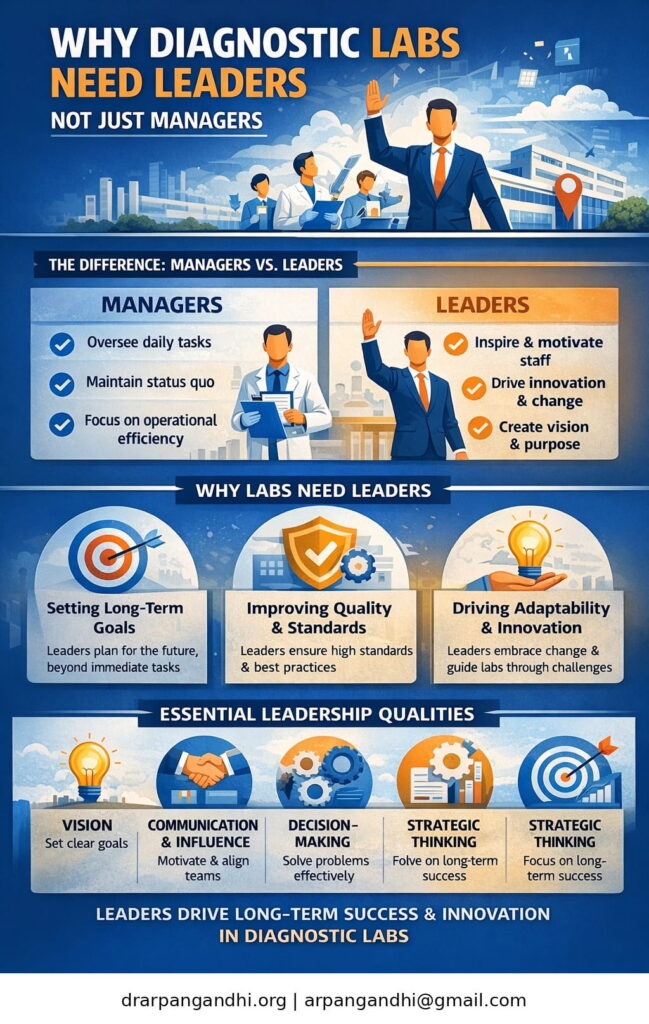
The Leadership Gap in Diagnostic Medicine: Why Management Alone Is No Longer Enough
By Dr. Arpan Gandhi
www.drarpangandhi.org
arpangandhi@gmail.com
In the last three decades, diagnostic laboratories in India have undergone a remarkable transformation. What began as small standalone facilities has evolved into large national laboratory networks processing millions of samples every day. Automation, high-throughput analyzers, laboratory information systems, and accreditation frameworks have modernized laboratory medicine. Despite these advances, one critical gap remains: leadership.
Most laboratories today are well managed, but very few are truly led. Management keeps the lab running, while leadership defines where the lab is going.
The Manager versus The Leader
A laboratory manager focuses on scheduling, daily volumes, manpower challenges, targets, and documentation. A laboratory leader builds culture, anticipates challenges, mentors teams, drives patient safety, and thinks patient-first rather than report-first. Managers complete tasks. Leaders create purpose. Both are important, but only leadership creates sustainable growth.
Why Diagnostic Labs Struggle Despite Good Management
Across diagnostic lab networks, strong SOPs, accreditation certificates, automated analyzers, and dashboards are common. Yet audit failures, staff attrition, communication gaps, pre-analytical errors, and burnout persist. The issue is not technology or infrastructure. The real problem is the absence of leadership culture. Machines can be bought and certificates earned, but culture must be built. In my years overseeing operations, I have observed that labs with strict ‘Speak-Up’ cultures reduce pre-analytical errors significantly faster than those relying solely on automation.
Leadership in Laboratory Medicine
Patient safety is central. Every sample represents a human life. Leaders question collection, transport, and clinical correlation. Managers close tickets, leaders prevent harm.
Creating a Speak-Up Culture
High-performing laboratories encourage questioning and learning from errors. Poor cultures suppress reporting and promote fear.
Beyond Accreditation
Accreditation is essential but does not equal quality. Leaders use audits to improve systems, invest in training, and monitor meaningful indicators.
Building Future Leaders
Without succession planning, laboratories become fragile. Strong leaders mentor professionals, upskill teams, and build second-line leadership.
Thinking Long-Term
Leaders think about the future of diagnostics, AI, workforce skills, and ethics. Managers focus on short-term targets.
Final Thought
Technology builds laboratories. Leadership builds institutions. Patients do not need faster reports. They need safer, smarter diagnostics.
I am currently exploring new avenues in laboratory leadership and peer review. If you are building a diagnostic network and value quality-first operations, I welcome a connection here or via email.